THYROID SPECIALIST – DHA LAHORE
Dr. Rizwan Niazi (MBBS, MRCP, MCPS, MD) provides specialist Graves’ disease management for patients in Lahore, DHA, and across Pakistan. Accurate diagnosis and a treatment plan built for your case.
گریوز ڈیزیز میں جسم کا مدافعتی نظام تھائیرائیڈ کو ضرورت سے زیادہ ہارمون بنانے پر مجبور کرتا ہے۔ اس سے دل کی تیز دھڑکن، وزن کم ہونا، اور بعض اوقات آنکھوں میں تبدیلیاں آ سکتی ہیں۔ یہ ایک قابل علاج بیماری ہے، بروقت تشخیص بہت ضروری ہے۔
Graves’ disease is an autoimmune condition and the most common cause of hyperthyroidism. The immune system produces specific antibodies that overstimulate the thyroid, causing it to produce too much hormone continuously.
Unlike other causes of overactive thyroid, where a nodule acts up or inflammation temporarily releases hormone, Graves’ disease is driven by TSH receptor antibodies (TRAb) that continuously push the thyroid into overdrive. This is why it needs a specific approach to diagnosis and treatment.
Graves’ disease is also closely linked to Graves’ Eye Disease (TED), a separate autoimmune condition where the immune system attacks the tissues behind the eyes. Not every Graves’ patient develops eye disease, but the connection is important to monitor.
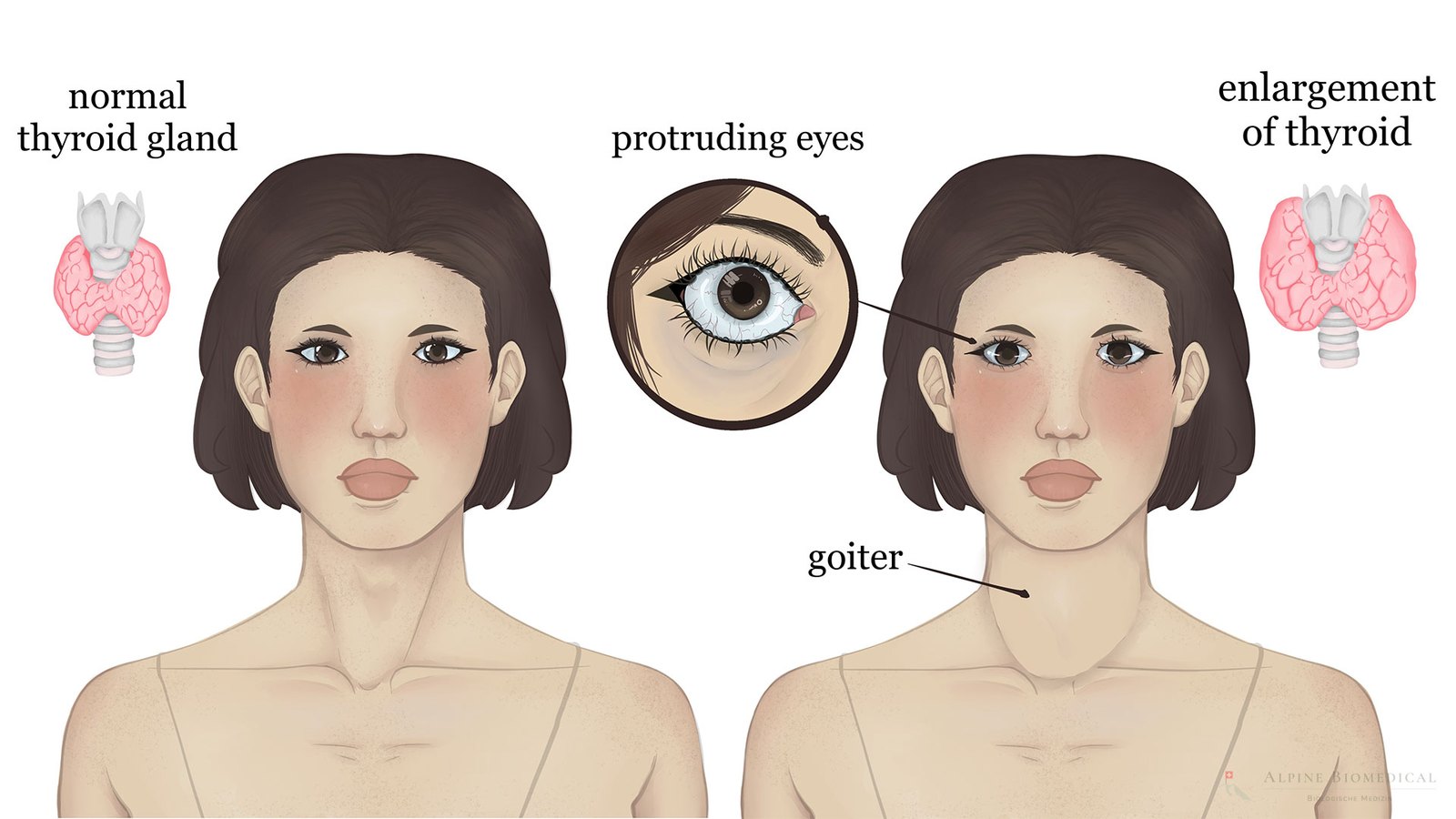
Graves’ disease causes all the symptoms of an overactive thyroid, plus specific features linked to the autoimmune process itself.
Unexpected weight loss, heart racing or palpitations, anxiety and nervousness, trembling or shaky hands, feeling too hot or sweaty, and insomnia.
Eye irritation, puffiness or bulging; an enlarged and firm thyroid gland; pretibial myxedema (skin thickening on the shins); double vision or eye movement changes; and eyelids pulling back.
You have an irregular heartbeat or chest pain, a sudden change in vision, an eye becoming red and painful, an inability to close the eye fully, or a feeling of impending fainting.
Confirming Graves’ disease, and distinguishing it from other causes of hyperthyroidism, requires specific blood tests. The results directly guide the treatment choice.
The initial blood tests confirm hyperthyroidism: a very low TSH with raised Free T3 and/or Free T4. This is the starting point for the full investigation.
Positive TRAb confirms Graves’ disease. This test is critical, as it distinguishes Graves’ from other causes of hyperthyroidism and also has implications for the risk of Graves’ Eye Disease developing or worsening.
If antibodies are borderline or the clinical picture is unclear, a thyroid uptake scan distinguishes diffuse Graves’ overactivity from a toxic nodule. This guides whether radioactive iodine is appropriate.
If there are any eye changes, Dr. Rizwan assesses for Graves’ Eye Disease (TED). This is important because certain treatments for Graves’ disease, such as radioactive iodine, need to be planned carefully if TED is active.
There are three treatment options for Graves’ disease. Dr. Rizwan discusses each option in full, including how they interact with any eye disease, and helps you choose the right path.
Tablets that reduce thyroid hormone production by blocking the gland from making hormone, usually the first-line treatment. Typically given for 12 to 18 months, around half of patients go into remission, the TRAb antibody level is monitored to guide when to stop, it is safe in pregnancy under close specialist supervision, and it can be combined with beta-blockers for heart symptom relief.
A single oral dose that permanently reduces thyroid activity and is very effective for Graves’ disease. Most patients develop hypothyroidism afterwards, which is easily managed. It cannot be used during pregnancy and requires careful planning if Graves’ Eye Disease is active. Dr. Rizwan coordinates an eye assessment before recommending it.
Removal of all or most of the thyroid gland, considered when the gland is very large, when other treatments are not suitable, or when the patient prefers a definitive solution and wants to avoid radioactive iodine. It gives an immediate, permanent result, is preferred with a very large goiter, does not worsen or trigger Graves’ Eye Disease, and Dr. Rizwan coordinates with thyroid surgeons in Lahore. Post-surgery thyroid hormone replacement is straightforward.
Graves’ Eye Disease is a separate autoimmune complication that can affect people with Graves’ disease. It is driven by the same antibodies and requires its own specialist assessment and management.
Graves’ disease is not just about controlling thyroid hormone levels. It requires understanding the autoimmune process, monitoring TRAb antibody levels, timing treatment decisions carefully, and assessing for eye disease at every visit.
Hyperthyroidism is the condition of having too much thyroid hormone, and it can have several causes. Graves’ disease is one specific cause, the most common, where autoimmune antibodies drive the overactivity. Not all hyperthyroidism is Graves’ disease, which is why the antibody test (TRAb) is so important.
Around half of patients with Graves’ disease achieve remission after a course of anti-thyroid medication, meaning the antibodies reduce and the thyroid returns to normal activity. For those who do not achieve remission, radioactive iodine or surgery offers a permanent solution.
No. Eye disease (TED) occurs in a minority of Graves’ patients, and when it does, it varies widely in severity. However, any eye change in a Graves’ patient should be assessed by a specialist, because early signs are easy to miss and early treatment prevents permanent damage.
Radioactive iodine can trigger or worsen Graves’ Eye Disease, especially if the eye disease is currently active. This is one of the most important factors Dr. Rizwan considers when planning treatment. If TED is active, radioactive iodine is approached with additional precautions or an alternative treatment is recommended.
Uncontrolled Graves’ disease in pregnancy carries risks for both mother and baby. However, with careful specialist management, most women with Graves’ disease have healthy pregnancies. TRAb antibody levels also need to be monitored in pregnancy as they can affect the baby’s thyroid.
TRAb antibodies are the cause of Graves’ disease, not just a marker. Their level predicts the likelihood of remission, the risk of eye disease, and whether it is safe to stop treatment. Dr. Rizwan monitors TRAb levels throughout treatment to guide decisions.
DHA LAHORE
Book a consultation with Dr. Rizwan Niazi for accurate diagnosis and a personalised treatment plan.
Suit# 154 CCA, DD, near Nadra office, Phase 4 Sector DD, DHA Phase 4, Lahore · Mon–Sat, by appointment